
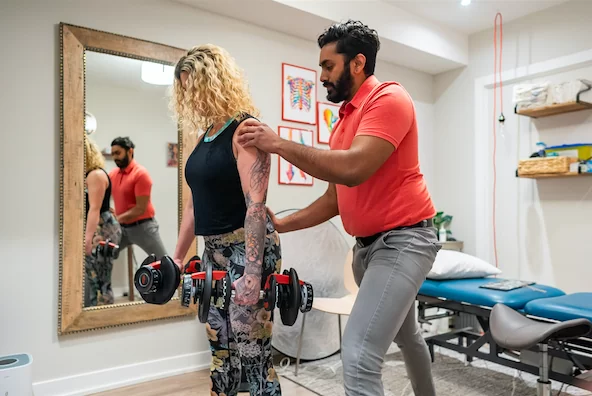
There is no better feeling than going to the gym and benching 2 plates. Deadlifting 4 plates. Squatting 3 plates. Stacking up the weights on the cable machine and watching it go up and down as you get your pump for the day. Unfortunately, we’re living in a time now where most of us don’t have the luxury of heavyweights and equipment. With all gyms closed in the province, many of my clients are discouraged to maintain their resistance training regiments, largely because, without heavyweights, there is a sentiment that very little can be done to adequately stress the muscles to promote muscle growth and development. Our innovative care strategies at For Health’s Sake will help you find quick relief.
The principle of progressive overload tells us that a continual increase in load needs to be applied to the body overtime to adequately stimulate muscle growth (Kraemer et al., 2004). In other words, the body will grow if presented with a challenge. If the challenge becomes too familiar to the body, it will not be challenging anymore, and your body will see no reason to grow. However, heavy weights and plates don’t define your physical state. After all, your muscles don’t clock in the fact that you just reached a new 1 rep max of 200lbs, 300lbs, or 400lbs. Muscles aren’t that smart, and they don’t know the numbers on the plates. But they do respond to tension and this tension can be continually induced in many ways.
Whether you have dumbbells, bands, or no equipment (body weight), the following are a few strategies to stimulate muscle growth during a lockdown, outside of heavy weights (Kraemer et al., 2004):
1. Increase load
a. Transitioning from bilateral to unliteral exercises (two limbs versus single limb)
i. Lower extremity – lunges, Bulgarian split squats, single leg deadlifts, single leg calf raises, single leg glute bridges, single leg hip thrusts
ii. Upper extremity – archer push ups, spiderman push ups, pullovers, banded single arm rows, banded single arm chest press, banded single arm overhead press
2. Manipulate Tempo of each repetition
a. Manipulate how long it takes to complete a rep, between 0.5 seconds per rep to 8 seconds per rep (Krzysztofik et al., 2019)
i. The longer it takes to complete a rep, the more tension is applied to the muscle
3. Increase Volume – more reps, more sets
a. Aim for 12 sets per muscle group per week or more (Krzysztofik et al., 2019)
b. 6-12 repetitions with moderate intensity of effort (60−80% 1RM) (Krzysztofik et al., 2019)
4. Training Frequency
a. Increase the number of days of training – between 2 days/week – 6 days/week (Kraemer et al., 2004)
i. Ex. go from a 3 day program (full body training each day) to a 4 day program (upper body/lower body/upper body/lower body) to a 6 day program (push/pull/legs/push/pull/legs)
ii. Aim to hit global muscle groups such as back, chest, legs, and core at least twice/week
5. Decrease Rest Interval
a. Short rest intervals ranging from 1-2min between sets (Kraemer et al., 2004)
i. Keep track of how long you rest between sets and seek to decrease the rest breaks between sets
By: Nirushan Guruparan
References:
Kraemer, W. J., & Ratamess, N. A. (2004). Fundamentals of resistance training: progression and
exercise prescription. Medicine and science in sports and exercise, 36(4), 674–688. https://doi.org/10.1249/01.mss.0000121945.36635.61
Krzysztofik, M., Wilk, M., Wojdała, G., & Gołaś, A. (2019). Maximizing Muscle Hypertrophy:
A Systematic Review of Advanced Resistance Training Techniques and Methods.
International journal of environmental research and public health, 16(24), 4897. https://doi.org/10.3390/ijerph16244897